
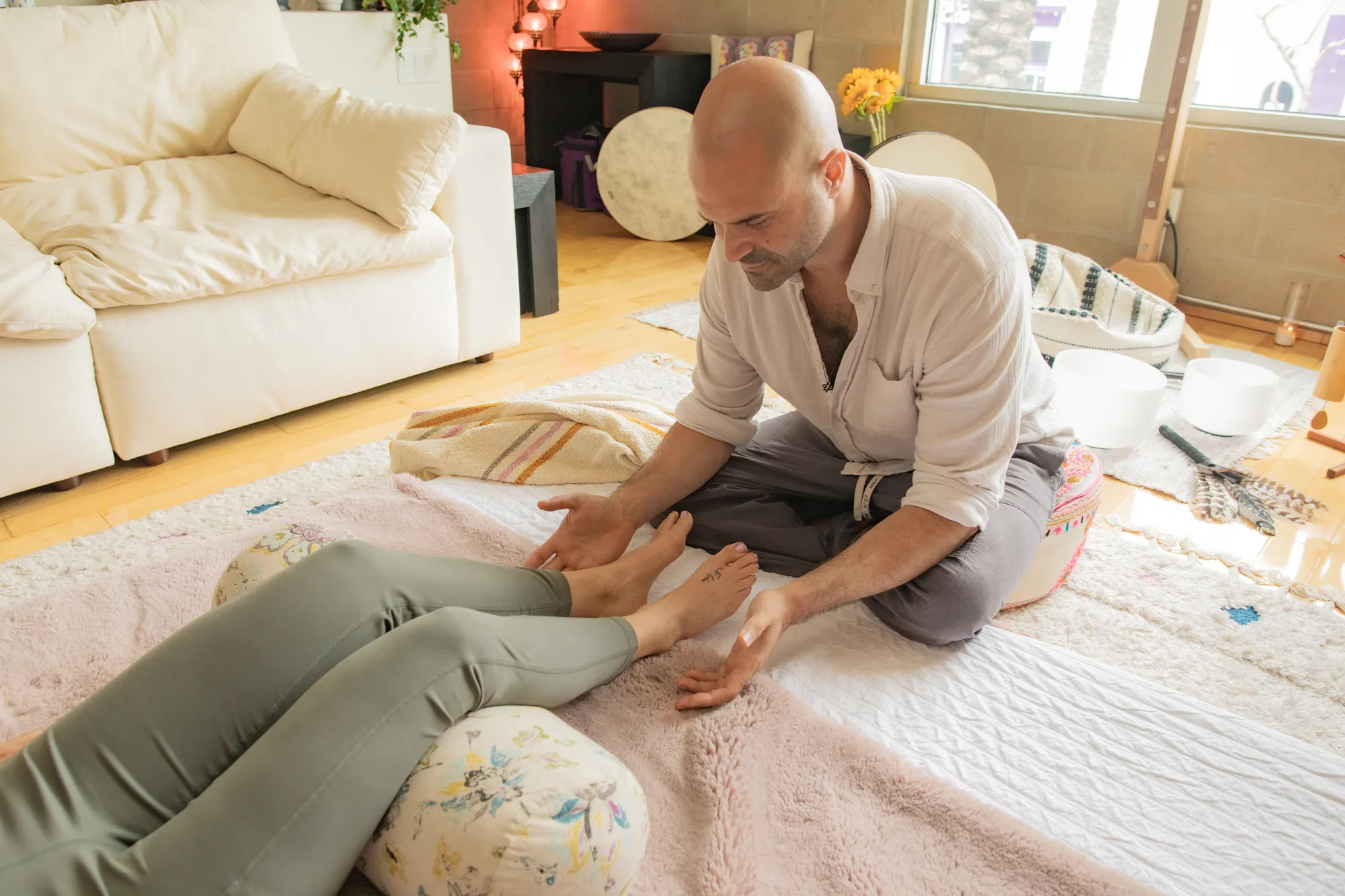
The root chakra is the first of the seven chakras, at the base of the spine. It holds your sense of safety and belonging, and whether the ground feels steady under you. When it wants attention, you usually feel it as a life that won't quite settle. That isn't a sign something is wrong with you. It's a sign there's room for more steadiness, and the root is a good place to begin.
What is the root chakra?
The root chakra (Muladhara in Sanskrit) sits at the base of the spine, around the pelvic floor and tailbone. It's traditionally associated with the color red and the element of earth.
We describe it the way you'd describe the roots of a tree. You can't see them, and they're doing most of the work. They anchor the tree and feed everything above them.
In the framing we teach from, Anodea Judith's, each chakra carries a right. The root's is the right to be here and to have. To take up space, and trust the ground will hold you while you do.
None of this is something you'd find on a scan. The chakras are a map, an old and careful one, of where certain human experiences tend to gather. That's how we use it.
Is my root chakra blocked?
If you searched for this, you're in good company. "Blocked chakra" is one of the most common phrases in the spiritual world, and we understand why it lands. When you feel off, it's a relief to have a name for it.
But we don't use that word in our practice, and we'd gently invite you to set it down too. A lot of what gets said about blocked chakras is spiritual fear-mongering. It tells you something inside you is broken and needs fixing, usually by someone else.
Energy itself is neutral. It can be more helpful or less helpful, and sometimes a heaviness settles at the root and stays a while. So instead of "blocked," we say things like:
- There's some dense energy at the root.
- The root could use some nourishment.
- There's something the root wants to process.
It sounds like a small change. It isn't. One version says you're broken. The other says you're alive, and there's room for more vitality here.
How to tell your root wants attention
We don't read physical symptoms off a chart. We aren't medical providers, and a chakra is not a diagnosis. What we can describe is how it tends to show up in a life when the root is asking for support:
- You feel unsteady, like the floor might shift even when nothing is actually moving.
- Themes of not belonging keep coming up, at work or with family, or even in your own skin.
- A general sense of being unsafe in the world, a low hum that doesn't attach to anything.
- Feeling disconnected or a little spacey, floating just above your own day.
- The practical side of life feels heavy: money, home, a body that needs feeding.
- Sometimes it goes the other way, into gripping. Holding on hard to things or people, and finding it hard to let anything go.
Most of us move through all of these at some point. None of it means you've failed at anything.
Start at the root
When life feels unstable, the root is often the most helpful place to start, even if what hurts lives higher up.
People rarely come to us asking about their root. They come with a heart that's hard to open, or a voice that goes quiet at the important moment. We wrote more about this in what it means to have your chakras aligned, but the short version is that the root holds up everything above it. A tree with nourished roots can reach higher, and a person who feels steady underneath can risk saying the true thing, or letting someone close.
The root is also the oldest layer. It forms before we have words, around how steady the world felt when we were small. So a lot of what you're running on now was set before you could have had a say in it. That's a reason for patience with yourself, not blame.
This part is mine
In our practice, Yonatan and I don't typically talk about chakras being blocked. I think it's fear-based language, and it can lead people to feel like something is wrong, when energy is really quite neutral.
Any healing is a shift toward deeper wholeness. That's not to say the place you're in is wrong. It's just acknowledging that there's space for deeper vitality and deeper health, and that it's ongoing.
It's a refreshing take that the two of us share, and I don't see it spoken about a lot in the spiritual space.
A two-minute root practice
This is the practice we open our free chakra course with. No equipment, nothing to get right.
- Sit somewhere comfortable. If you can, take your shoes off and put your feet on grass, sand, or soil. A floor works too.
- Place one hand on your low belly.
- Take ten slow breaths that press gently into your hand. Let the exhale be a little longer than the inhale.
- Then finish this sentence, in a notebook or just in your head: "I feel most grounded when..."
That's it. Small on purpose. If you want to go a little further, here are the questions we sit with across the root days in Inner Alchemy:
- What does safety mean to me, emotionally, physically and spiritually?
- What habits could I weave into my life to feel more deeply rooted?
- What has tested my foundation, and how did I grow stronger through it?
Other ways to nourish your root
- Move your lower body. Walking, squats, and standing postures like Warrior bring attention down into your legs and feet. Slow is better than hard here.
- Write it down. Our Chakra Alignment workbook uses the seven centers as a way to locate where you feel tight, starting at the root.
- Eat like you're staying. Warm, grounding food, root vegetables, enough protein, enough water. Regular meals tell the body it's safe.
- Bring the earth inside. A plant on the desk, a stone in your pocket. Time outside under actual trees counts for more than you'd think.
- Say it out loud. "I am safe, and I am allowed to be here." It may feel silly at first. Say it anyway.
Where to go from here
If you'd like to meet all seven chakras this way, one a day, our free course 7 Days, 7 Chakras starts at the root and works up. One short email a day and a practice under five minutes. It's yours whether or not we ever meet.
And if you want to stay with each center longer than a day, Inner Alchemy is our 28-day self-paced course, with three days on the root alone, plus a root movement practice and meditation to return to each day.