You know the kind of quiet that isn't quiet. The house has settled and your phone is face down, but your mind is still rewriting this morning's email. Now picture one note from a quartz bowl in that same silence. It takes a long time to fade. You follow it down until you can't tell whether it has stopped.
Something shifted in those few seconds, because your attention moved. How much more than that is going on? That's the real question in the science of sound healing, and the claims run from careful to overblown, so it deserves a straight answer. We offer sound healing in Los Angeles, and we have every reason to want the most flattering version of this story. Here is the honest one, as best we can read the studies today.
What sound healing is
Sound healing is a broad name for resting or meditating inside live sound. A sound bath is usually a group lying on mats while someone plays bowls, gongs and chimes. A private session is the same idea, shaped around one person.
Four things get blurred together online, and the blur causes most of the confusion.
- Music listening is what it sounds like, and a lot of the research is this, often recorded music offered by a nurse or a researcher.
- Music therapy is a clinical profession. The American Music Therapy Association defines it as evidence-based music interventions delivered "by a credentialed professional who has completed an approved music therapy program."
- Vibroacoustic therapy combines low-frequency sound vibration with music listening and therapeutic interaction, usually in a rehabilitation or clinical setting.
- Sound healing comes out of contemplative practice and has no single standard protocol.
This matters because a result from a hospital music therapy trial doesn't automatically transfer to a sound bath. The person leading it is trained differently, and the goal usually isn't the same. Below, we'll say which kind of study we're describing.
What happens when we listen
The National Institutes of Health puts it plainly: listening to music activates brain structures involved in thinking, sensation, movement and emotion, and it releases brain chemicals that can evoke feelings and memories. That's why a song can undo you in a grocery store.
Rhythm has its own pull. EEG research suggests brain activity can lock onto a musical beat, a process called entrainment. That tells us something about how the brain tracks rhythm. It doesn't show that a gong can steer your brain into a healing state.
Then there's the part musicians may enjoy most. In a small lab study of 24 people, faster music raised breathing, blood pressure and heart rate. A two-minute pause brought those numbers below where people started, and the authors put "the importance of silence" in their title.
What the research shows
Stress. NIH summarizes a 2020 review of 104 studies and 9,617 people: music-based interventions had a small-to-medium effect on physical stress measures and a medium-to-large effect on psychological ones.
Anxiety. A 2025 meta-analysis of 51 music therapy trials found a medium effect on the anxiety people reported. The effect on physiological measures was small and not statistically significant. So people felt less anxious, and the instruments didn't reliably confirm a matching change in the body. The feeling is no less real for that. The physical story is simply less settled than wellness marketing suggests.
Sleep. In a 2022 review NIH describes (13 studies, 1,007 people with insomnia), listening to music had no effect on insomnia severity. It did improve how people rated their sleep quality, with moderate-certainty evidence.
Pain. A 2025 meta-analysis of nine randomized trials and 787 patients found music therapy reduced chronic pain and depression, with no clear effect on anxiety or quality of life in that group. An earlier review found a stronger effect on chronic pain when people chose the music themselves.
NIH's own caution is that much of this research is preliminary and few definite conclusions have been reached. And the studies above tested music therapy and music listening, not sound baths.
| Topic | Where it stands |
|---|---|
| Music and perceived stress or anxiety | Relatively consistent, mostly from music therapy and music listening studies |
| Music and subjective sleep quality | Moderate certainty for music listening; insomnia severity did not change |
| Music and chronic pain | Encouraging, varies by condition; post-surgical chronic pain did not improve |
| Singing bowls and mood or tension | Encouraging but preliminary, small studies |
| Bowls and heart rate variability or EEG | Preliminary, not a predictable outcome |
| A sense of spaciousness, or something sacred | Personal experience and tradition; research isn't built to measure it |
| Specific frequencies healing cells | Unproven |
Why singing bowls and vibration are interesting
A bowl gives you a long tone full of overtones, and you can feel it as well as hear it. That combination is why researchers have started paying attention, and the reviews now cover more studies. A 2020 review found only four studies and declined to recommend bowl therapy. By 2025, one review had 19 clinical studies and another had 14.
Both 2025 reviews report signs of less anxiety and better mood, and neither found serious harm. They're also frank about the limits. The first rated all of its randomized trials at high risk of bias. The second looked at studies of 12 to 81 people, mostly single sessions or short programs, too varied to pool. A 62-person study from UC San Diego found less tension, anger, fatigue and depressed mood after a bowl and gong meditation, and first-timers dropped the most in tension. It also had no control group, as its authors note.
Vibration itself is real physics and a real sensation. A narrative review maps possible effects of low-frequency vibration on blood flow, nerves and muscle, though that work mostly involves applied vibration at set frequencies, which is different from sitting near a bowl. For vibroacoustic therapy and pain, a 2022 scoping review of 20 studies called the research too sparse to say what helps. Nobody knows yet whether vibration adds something beyond the sound and the rest.
Sound healing and the nervous system
You'll hear that a session gives you a "nervous system reset." We understand the appeal of the phrase, and it describes how some people feel afterward. As biology, there's no reset button. Your stress response shifts gradually, and it shifts differently in different people. We've written separately about what a session is like for a tired nervous system. Here we'll stay with the evidence.
What we can say is that a session puts a few things together that plausibly help. You're lying down with nothing to answer, and your attention has one thing to follow. We open with breath, and deliberate slow breathing has stronger evidence behind it than sound does: a meta-analysis drawing on 223 studies linked it to increases in a heart rate variability measure tied to the body's rest response. Some bowl studies also include breathing or other practices, so it's often hard to say which piece is doing what.
Three of four controlled studies in the Tibetan bowl review reported higher heart rate variability. Heart rate variability, cortisol and EEG patterns are things researchers measure, and they don't move on command.
Live sound may matter too. In one study of 37 listeners, heart measures suggested less physiological stress during a live piano performance than during its recording, although the authors warn that the fixed order of the sessions and the sound quality could explain some of it.
Sound isn't comfortable for everyone. Gongs can get loud, and NIH notes that long or repeated exposure at or above 85 decibels can cause hearing loss. Music can also stir up memories that hurt. If you have tinnitus or sound sensitivity, tell us when you book so we can change the instruments and the volume. If you have a history of epilepsy or severe migraine, check with your clinician first.
What the science has not established
No study we found shows that a sound session repairs DNA, regenerates cells, detoxifies the body or cures disease in people. A session doesn't replace medical or mental health care. It can sit alongside them.
Specific frequencies are where the claims outrun the data fastest. A crossover trial of 43 cancer patients found heart rate fell with sound tuned to either 432 Hz or 443 Hz. The drop was a little larger at 432 Hz, and one measure, pulse wave velocity, differed significantly in its favor. Several others didn't. A 33-person pilot found a lower heart rate with 432 Hz music than with 440 Hz. A trial of 162 students saw some saliva markers shift with 528 Hz and 432 Hz music, with no difference on a cognitive test. None of that gets near cellular healing.
Binaural beats are a different thing altogether: two slightly different tones, one in each ear, which means headphones rather than a bowl across the room. A 2023 review of the claim that they entrain brainwaves found five studies in favor, eight against and one mixed. A 2026 review of music and binaural beats in young adults found modest benefits for sleep and anxiety, limited by small samples.
Bells, gongs and chant have been part of Buddhist and Hindu practice for centuries. If an hour of sound feels sacred to you, no trial needs to sign off on that.
The experience at Word of Mouth
Sessions are private and in person, at our studio near Highland and Melrose. Yonatan leads them. He has spent 30 years as a musician and composer, and he's also a Usui Reiki Master and a certified conscious connected breathwork facilitator.
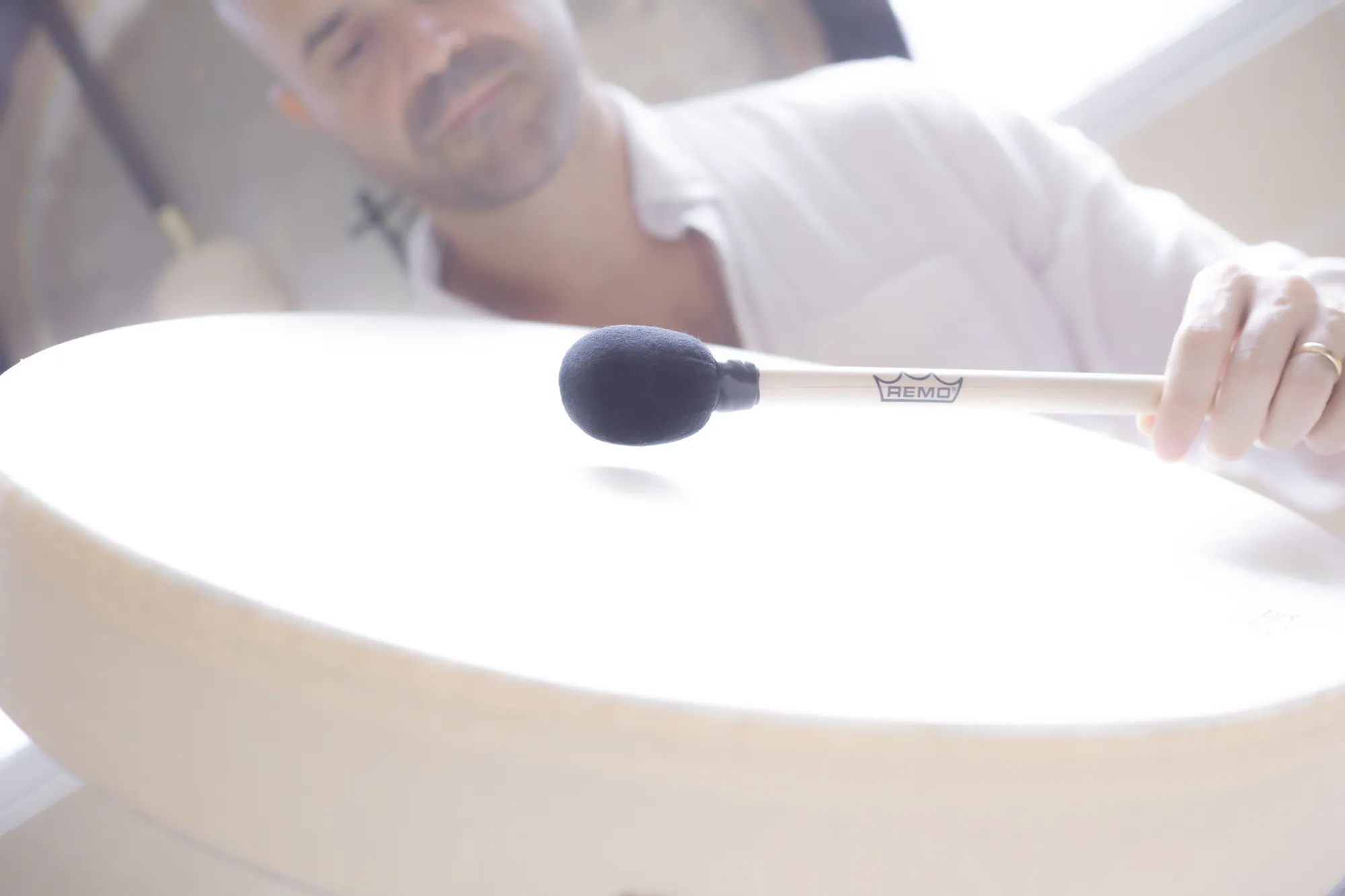
You'll have tea when you arrive, and you'll talk for a few minutes about what brought you in. We open with breath. From there, the sound might include quartz bowls and gongs, the black baby grand, tuning forks, drumming, voice, and music Yonatan composed himself. Reiki is usually carried through the sound, and depending on what the session needs, he may move to recorded music and offer it hands-on. Nothing is on a fixed track, so a day that calls for less gong gets less gong.
This is sound healing. It isn't music therapy, which is its own credentialed clinical field, and we can't promise what you'll feel. Plenty of people come for the rest. Others spend the hour thinking something through.
Letting yourself listen
Some of what happens when you lie down and listen can be measured, but the studies can't tell you what an hour will do for you.
If you'd like to find out, you're welcome to book a private sound healing session.
Questions about the research
Is sound healing scientifically proven?
Not as a treatment for any condition. Music therapy and music listening have a stronger research base, especially for perceived stress and anxiety. Sound bath and singing bowl research is newer and promising, and much of it comes from small studies.
What are the benefits of a sound bath?
The best-supported ones are subjective: feeling less tense and in a better mood afterward. Many people also value the rest itself. Those findings come mostly from small studies, so treat them as possibilities, not guarantees.
Can singing bowls help with anxiety or stress?
They may. Two 2025 systematic reviews report reductions in anxiety in many of the studies they cover, with no serious harm reported. Many of those studies are small or carry a high risk of bias. If anxiety is affecting your daily life, bowls can sit alongside care from a clinician.
Does sound healing affect the nervous system?
Possibly, in the ordinary way that rest, slower breathing and focused attention do. Some bowl studies report higher heart rate variability or a lower heart rate. Results vary, and "nervous system reset" is a metaphor, not an established biological process.
What is the difference between sound healing and music therapy?
Music therapy is a clinical profession practiced by a credentialed therapist working toward individual health goals. Sound healing is a contemplative practice with no single standard protocol. Results from music therapy trials don't automatically apply to a sound bath.
Do specific healing frequencies actually work?
Small trials have compared tunings such as 432 Hz with standard pitch, and the evidence is limited, with small differences. A few lab-dish experiments exist, but no study we found shows that a 432 Hz or 528 Hz session heals cells or repairs DNA in people.
What should I expect during a private sound healing session?
Tea, a short conversation about what brought you in, and a few minutes of breath, then live sound shaped around you. You can lie down and there's nothing to get right. Tell us about tinnitus or sound sensitivity when you book, and we'll adjust.